

When we think about classroom management, we tend to think about the big things—rules, expectations, behavior systems, and consequences. But after more than 20 years in the classroom, I’ve learned that sometimes it’s the smallest things that cause the biggest headaches.
The missing pencils. The marker someone finds on the floor and absolutely must return to its owner in the middle of your lesson. The chorus of “Can we use markers?” immediately after you’ve explained what materials students will need.
And, of course, the untied shoe that somehow needs your attention just as you’re trying to get 24 students out the door.
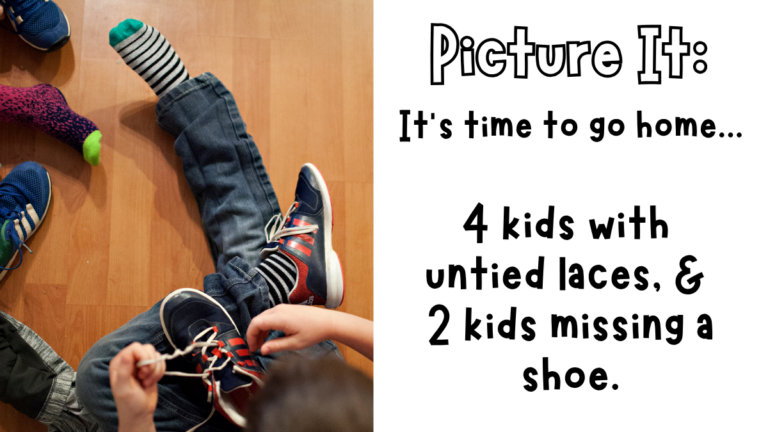
None of these things seem like a big deal on their own. But multiply them by 20-something students, five days a week, and those little interruptions add up.
That’s why some of my favorite classroom routines aren’t complicated behavior systems at all. They’re simple solutions to the small, everyday problems that can quietly steal your time, interrupt your lessons, and make your classroom feel more chaotic than it needs to be.
The “What Do We Need?” Routine
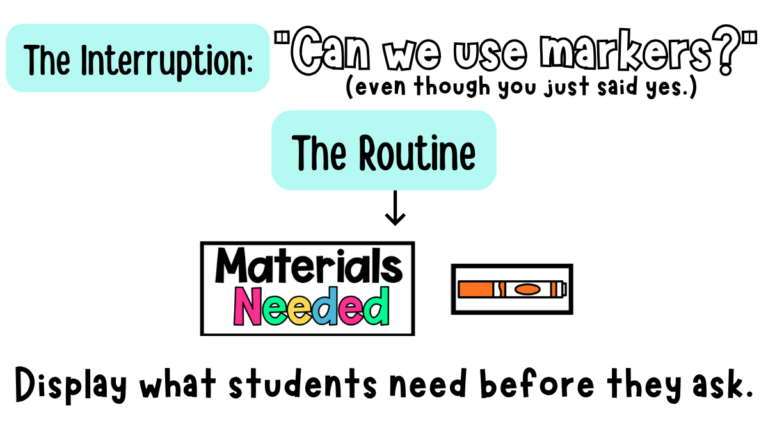
We’ve all been there. You explain an activity, tell students exactly what they need, and approximately three seconds later someone asks, “Can we use markers?” Then someone else wants to know if they need scissors. And before you know it, you’re answering the same question five different ways.
One simple routine that has made a difference in my classroom is displaying exactly which materials students will need. Before we begin, I put up visual cards for pencils, crayons, scissors—or whatever we’ll be using that day. Instead of answering the same questions over and over, I can simply point students back to the visual.
It’s a small thing, but that’s really the point. The fewer little questions students need to ask me, the more independently they can get started.
Once students know what materials they need, the next challenge is making sure those materials actually survive the school year.
The Great Pencil Drama
I finally reached my limit with lost, broken, and destroyed pencils. Honestly, everything was fine until after COVID. Taking care of materials was a “thing of the past,” and pencils became fidgets, toys, and apparently snacks.
Suddenly, it was more common for students not to have a pencil than to actually have one. Every lesson seemed to begin with what I started calling The Great Pencil Quest.
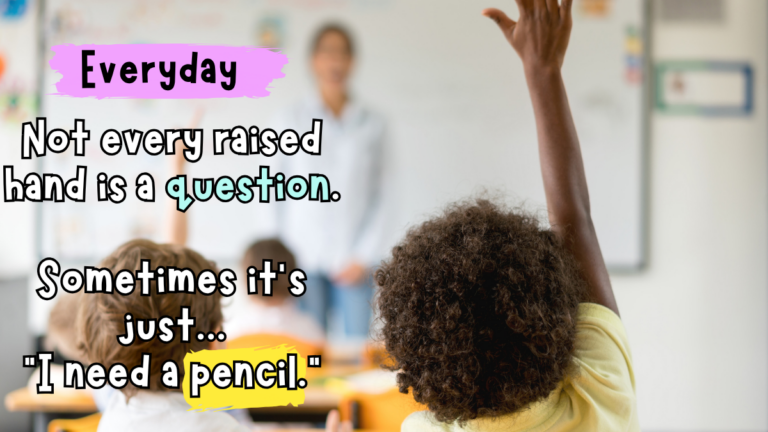
If you teach primary grades, you know pencils can somehow become an entire classroom management issue of their own. They’re chewed, snapped, sharpened down to practically nothing, or mysteriously missing five minutes after you hand them out.
That’s how my Pencil Challenge started. Over the years I’ve done this a couple of different ways, depending on the needs of the class. I either write students’ names on their pencils or assign each student a number. Here’s how I usually do it. Each student is assigned a number, and I write that number on their pencil. I also put matching paper pencil numbers into a cup. At random times, I draw a number. If that student still has their pencil and hasn’t destroyed it, they earn a small reward or privilege.
The random part is what makes it fun. When I pull a number, suddenly everyone wants to know, “Whose number is 12?!”
And because students never know when I’ll draw, there’s a little extra motivation to keep track of their pencil.
Want to see the Pencil Challenge in action? I shared a quick video on Instagram that shows exactly how it works in my classroom. Click below to check it out.
But keeping track of pencils is only half the battle. There is still the broken pencil. The dull pencil. The pencil that suddenly stops working at the exact moment you’re in the middle of teaching.
That’s why I also use a simple sharp-and-dull pencil exchange. Students know exactly what to do when their pencil needs to be sharpened: exchange it for a sharp one and keep working. No asking. No waiting for me. And, most importantly, no pencil sharpener becoming the most exciting destination in the classroom.
When pencils get worn down, I simply hand out a fresh set and the challenge continues. I also keep extra pencils available, so a lost pencil never needs to become a full classroom emergency.
The “Whose Marker Is This?” Routine
How many times has this happened? You’re right in the middle of a lesson when suddenly someone calls out, “Whose marker is this?”
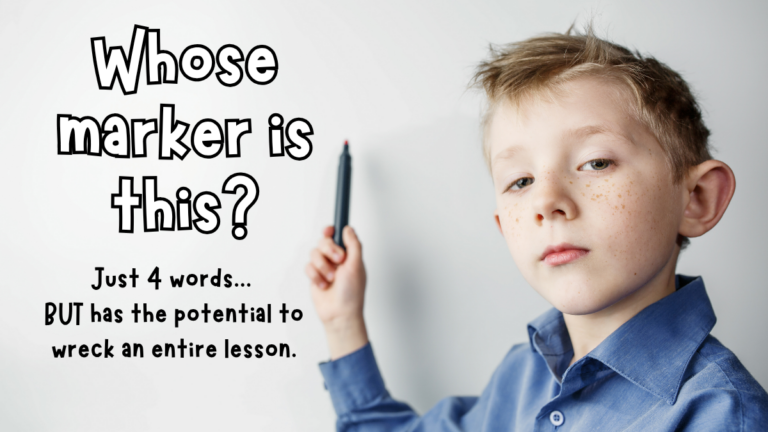
Because, of course, at that moment, finding the owner of one random marker is of the utmost importance. 😂
And it’s never just markers. It’s a glue stick. A crayon. A pair of scissors. A tiny broken piece of an eraser that absolutely must be reunited with its rightful owner immediately.
That’s why I have a designated spot for lost supplies. If a student finds something that doesn’t belong to them, it goes there. No investigation necessary. No interrupting a lesson to poll the class about the ownership of one lonely purple crayon.
Students also know exactly where to look when something is missing. The routine works both ways:
Found something? Put it there.
Lost something? Check there first.
Again, it’s incredibly simple. But that’s exactly why it works. It gives students a clear answer to “What do I do with this?” without needing me to be part of the solution every single time.
Mission: Tie Possible
Then there are the interruptions that aren’t really behavior problems at all—but still somehow always seem to happen when you don’t have a spare minute.
Like untied shoes. They always seem to come untied at the worst possible time—lining up for recess, heading to specials, or walking out the door at dismissal.
Some years, it feels like shoe tying is becoming a lost art. And while I’d love to sit down and give every student a personal shoe-tying lesson, the reality is that I don’t always have the time.
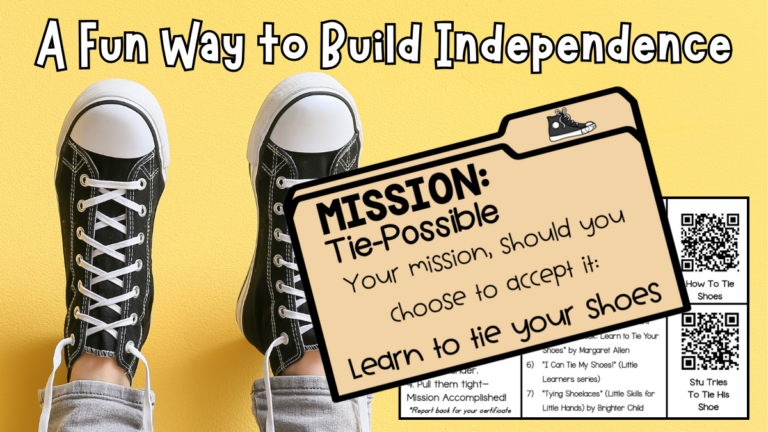
So I decided to turn learning to tie shoes into a mission: Mission: Tie Possible.
I start by finding out which students already know how to tie their shoes and which students are still learning. Not everyone needs to participate, which is why I use a simple checklist to keep track. The students who already know how to tie their shoes can also become helpers, giving students another option besides automatically coming to me every time a shoe comes untied.
For students who are still learning, I send home their mission disguised as a fun activity. They get resources to practice at home, and when they can successfully tie their own shoes, they’ve completed the mission.
Small Routines Make a Big Difference
The idea behind all of these routines is simple: cut down on the little interruptions that pull our attention away from teaching and students’ attention away from learning.
One lost pencil isn’t a big deal. One student asking if they can use markers isn’t a big deal. One mystery glue stick or untied shoe isn’t a big deal.
But when you add up all of those little moments over the course of a day, a week, or an entire school year, they can take more of our time and energy than we realize.
I’ve found that some of my most useful classroom routines have come from simply noticing the questions I’m tired of answering or the problems I’m tired of solving over and over again.
Sometimes, that’s the best place to start.
What little interruption keeps happening in your classroom—and could a simple routine solve it?
Many of the routines I shared in this post didn’t start as printable resources. They started as solutions to real classroom frustrations I experienced year after year. Eventually, I gathered the tools I was using into one place so I didn’t have to recreate them each August.
If you’d like to use these routines in your own classroom, I’ve gathered the printable tools I use into my Classroom Management Starter Pack. It includes the Materials Needed cards, Pencil Challenge, Lost & Found routine, Mission: Tie Possible, and several other classroom management tools designed to help build simple routines from the very beginning of the school year.
✏️ Click here to take a look at the Classroom Management Starter Pack.